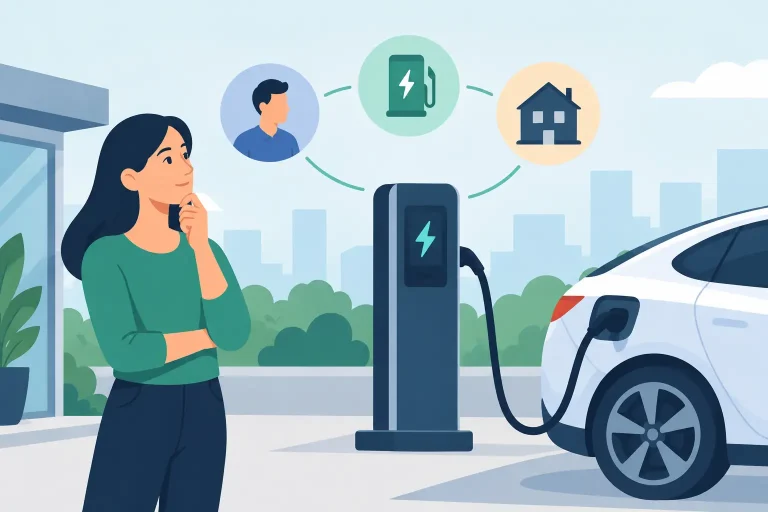
A public charger can get you through a busy week. Home charging changes the daily experience of owning an EV. You park, plug in, and wake up with the range you need – without adding a charging stop to tomorrow’s schedule.
For most drivers, the question is not whether charging at home is worthwhile. It is what kind of setup fits the vehicle, the electrical system, and the way the household actually drives. A professionally planned installation keeps the answer simple while protecting the safety, speed, and long-term value of the system.
Why home charging is the EV convenience most drivers use
Public fast charging has a role, especially on road trips or during unexpectedly busy days. But it is rarely the most convenient way to cover routine driving. At-home charging lets the vehicle replenish its battery while it is already parked for the night, which is often the longest stretch of downtime it has all day.
That routine also gives drivers more flexibility. You can start each morning with a predictable amount of range, schedule charging for off-peak utility hours when available, and avoid waiting for an open public station. For a household with one EV, that can be a major quality-of-life improvement. For two EVs, a well-designed setup becomes even more valuable.
The best system is not automatically the highest-powered one. It is the one that comfortably replaces the miles driven between parking periods without pushing the home electrical system beyond what it can safely support.
Level 1 vs. Level 2 home charging
The charging level determines how quickly an EV adds range. Level 1 uses a standard 120-volt outlet. It is included with many vehicles and can work for drivers with short daily commutes, a lot of overnight parking time, and no need to recover significant range quickly.
The trade-off is speed. Level 1 commonly adds only a few miles of range per hour. If a driver uses 40 or 50 miles of range each day, a standard outlet may not fully catch up overnight. It can also be a poor fit when temperatures are extreme, the household has more than one EV, or the vehicle needs to be ready for frequent longer trips.
Level 2 charging uses a dedicated 240-volt circuit, similar to the power used by major appliances. Depending on the vehicle, charger, circuit size, and electrical capacity, it can add substantially more range per hour than Level 1. For many EV owners, Level 2 is the practical choice because it makes overnight charging dependable rather than conditional.
A Level 2 charger does not always need the maximum available amperage. A properly sized 32-amp, 40-amp, or higher-capacity setup may be appropriate depending on your needs. The charger itself, the vehicle’s onboard charging capability, and the available panel capacity all matter. Installing more equipment than the property can use safely is not an upgrade.
Hardwired chargers and plug-in outlets
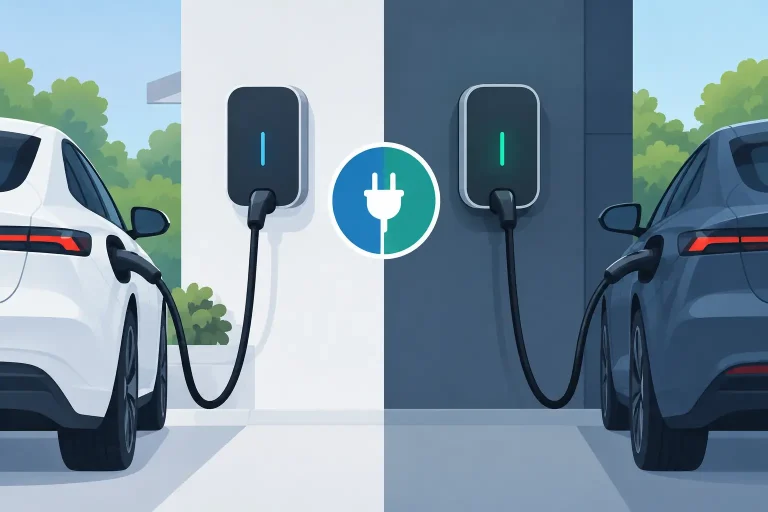
A Level 2 charger can be hardwired directly into the electrical system or connected through a correctly installed 240-volt outlet. Both approaches can work, but they serve different situations.
Hardwired units are often a strong long-term choice. They eliminate the outlet connection, can support higher charging loads when the electrical design allows, and are typically well suited to outdoor installations. A plug-in configuration can offer flexibility if you may want to replace or relocate the charger later. The right choice depends on the equipment, location, and the property’s electrical plan.
Start with your driving routine, not the charger model
It is easy to choose a charger based on a headline number. A better first step is to look at your actual driving. Consider your typical daily miles, how many hours the vehicle is parked at home, and whether the car needs to share the charging setup with another EV.
A driver who travels 25 miles most weekdays has different needs from someone who drives 100 miles daily for work. Likewise, a household that can charge every night has more flexibility than one where cars rotate through a single garage space.
Your vehicle’s charging limit matters, too. Some EVs cannot accept the full output that a higher-amperage charger can provide. In that case, buying a more powerful unit may not make the vehicle charge faster today. It could still make sense for a future vehicle or a shared charging arrangement, but that is a planning decision, not a requirement.
Smart charging features can be useful, particularly when they allow scheduled charging, energy tracking, or load sharing between two chargers. Still, dependable electrical work matters more than a long list of app features. A simple, properly installed charger is better than an advanced unit installed on an unsuitable circuit.
Your electrical panel sets the starting point
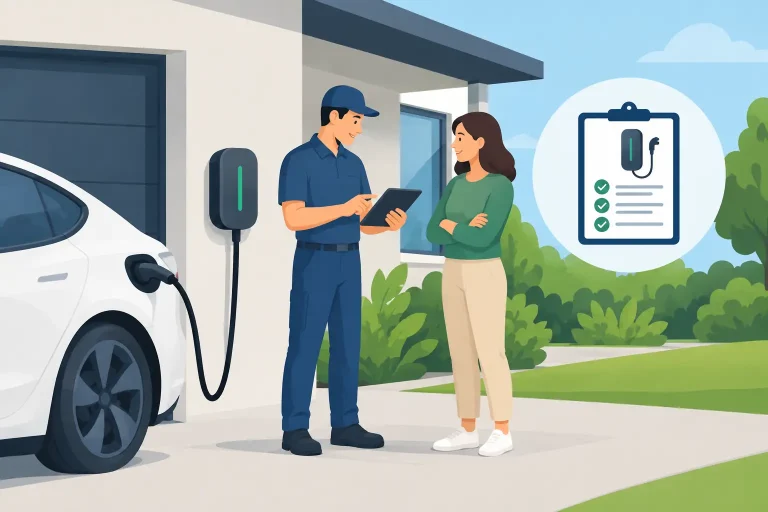
Before installing a Level 2 charger, a licensed electrician should evaluate the panel and calculate the property’s available electrical capacity. This is not simply a matter of looking for an empty breaker space. A panel may have open spaces while still lacking the capacity to add a continuous EV charging load without changes.
The evaluation considers existing appliances and loads, such as air conditioning, electric dryers, ovens, pool equipment, heat pumps, and solar-related equipment. In older homes, the panel rating, wiring condition, and distance from the panel to the charging location can all affect the installation plan.
Sometimes the answer is straightforward: install a dedicated circuit and charger. In other cases, the project may call for a subpanel, a load-management device, or a panel upgrade. These options are not signs that the project has gone wrong. They are ways to build a charging setup that works safely with the home rather than competing with it.
Load management can be particularly helpful when a full panel upgrade would be costly or unnecessary. It monitors and adjusts charging demand to help keep the home’s electrical load within safe limits. Whether it is the right option depends on local code, utility requirements, existing equipment, and the household’s usage patterns.
Location affects convenience, cost, and durability
The best charger location is usually close enough to the vehicle’s charging port that the cable reaches without stretching across a walkway or driveway. It should also allow the cable to be stored neatly when not in use. A charger placed too far away can create daily frustration, even if the electrical installation is technically sound.
Garage installations are often more protected from weather and may require a shorter wiring run. Outdoor installations can be just as effective when the equipment is rated for the environment and positioned thoughtfully. Mounting height, weather exposure, physical protection, and cable management all deserve attention.
The route from the electrical panel to the charger matters because longer runs can increase labor and material costs. Running wiring through finished walls, across large properties, or through difficult access areas can change the scope of work. A clear installation quote should account for these property-specific factors rather than treating every home as identical.
Permits are part of doing the job correctly
EV charger installations commonly require permits and inspections. Requirements vary by jurisdiction, and properties in Los Angeles County may also have local rules that affect the process. The permit is not just paperwork. It helps confirm that the circuit, wiring, breaker, equipment, and installation methods meet applicable safety standards.
Homeowners should be cautious about anyone who suggests bypassing permits when they are required. An unpermitted installation can complicate future home sales, insurance questions, inspections, and electrical upgrades. It may also leave the owner without confidence that the charging equipment was installed to code.
A specialized EV charger installer can coordinate the technical details, handle permit support, and make the process much less time-consuming for the homeowner. That is especially useful when the project involves a panel upgrade, a complex wiring route, or local inspection scheduling.
Condos and shared parking need an earlier conversation
Home charging in a condo, townhome, or apartment community can be very achievable, but it usually involves more stakeholders. The parking space may be deeded, assigned, or common area. The electrical meter may serve an individual unit or the broader property. HOA approval, property management coordination, and access to electrical rooms can all affect timing and design.
Starting early is the best way to avoid delays. An installer can assess where power can be sourced, estimate the path for wiring, and identify whether the charger should be billed to an individual resident or managed as part of a shared system. For property managers, planning for future EV demand is often smarter than solving each request as an isolated project.
A scalable approach may include conduit capacity for future chargers, load management, or a shared charging plan. It costs less to think ahead while work is already underway than to reopen walls or pavement later.
Choose installation quality over a quick workaround
An EV charger is a high-demand electrical appliance that may operate for hours at a time. That makes circuit sizing, breaker selection, wire routing, equipment mounting, and code compliance essential. Extension cords, improvised adapters, and overloaded household outlets are not substitutes for a dedicated charging solution.
A qualified installer should explain what the property needs in plain language, provide upfront pricing based on the actual scope, and stand behind the completed work. At Plug-in LA, certified electricians help homeowners choose compatible equipment and handle the installation details from quote through completion.
The goal is not to turn your garage into a technical project. It is to make charging feel like the easiest part of driving an EV. Once the right system is in place, plugging in when you get home becomes a small routine that gives every next drive a more predictable start.