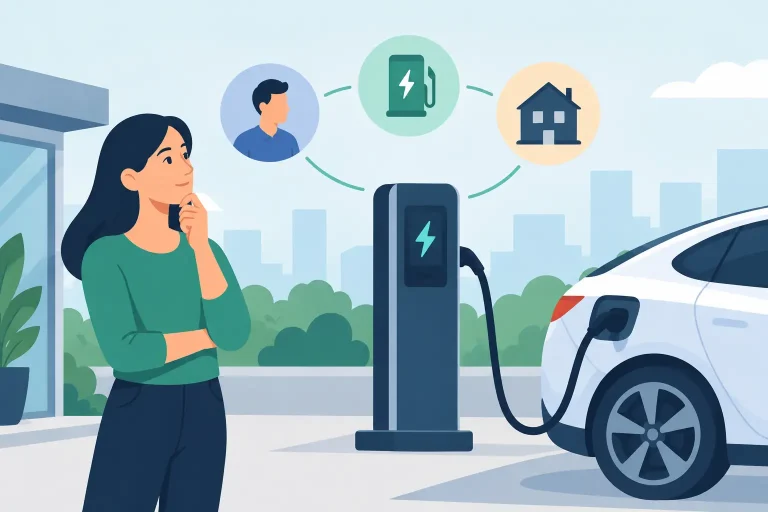
A condo board receives its first EV charging request, then a second one arrives a few months later. The question quickly shifts from, “Can we approve this?” to, “How do we create a process that is fair, safe, and affordable for everyone?” This HOA charging case study follows a common multifamily scenario and shows why the best result is rarely a simple yes or no.
For many HOAs, the pressure is real. Residents want to charge where they park, California EV adoption continues to grow, and leaving every request to be handled as a one-off can create inconsistent rules, unnecessary electrical work, and frustration on both sides. A thoughtful plan gives the board control while giving residents a practical path forward.
The Property: Growing Demand, Limited Infrastructure
Consider a 48-unit condominium community in Los Angeles County with one underground garage. Each home has an assigned parking space, but the spaces are not directly connected to individual electrical meters. The garage lighting, gates, and other common-area equipment are powered through the HOA’s shared electrical service.
The board initially received three requests for Level 2 charging. Each driver was willing to pay for their own charger, but the board had larger concerns: Who would pay for electricity? Would the main panel support additional load? What happens when ten more residents request chargers? Would equipment installed for one resident become an HOA maintenance obligation later?
Those are the right questions to ask before approving equipment. A Level 2 charger is a significant electrical load, and a garage may have capacity constraints that are not obvious from a quick visual inspection. At the same time, postponing every request until the HOA develops a perfect long-term plan can leave residents without a reasonable charging option.
The board needed a solution that could meet current demand without closing off better options in the future.
HOA Charging Case Study: The First Step Was a Site Review
The first move was not choosing chargers. It was evaluating the property’s existing electrical infrastructure.
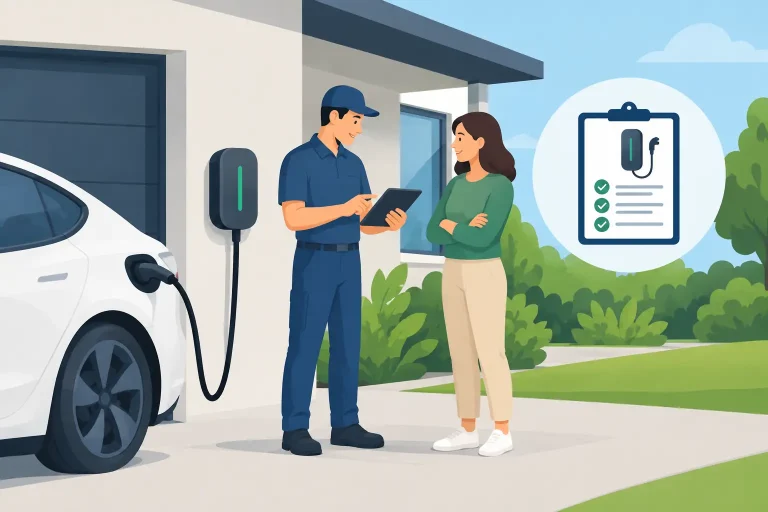
A licensed EV charging electrician reviewed the main electrical service, distribution panels, available conduit pathways, garage layout, assigned-space locations, and the distance between the electrical room and the requested spaces. The review also considered planned capital projects and common-area loads, such as ventilation equipment and garage lighting.
This assessment identified enough capacity for an initial group of chargers, but not enough unused capacity to support unrestricted charging at every parking space. That finding changed the conversation. Rather than treating each request as a separate electrical installation, the board could build an expandable charging system designed around the garage’s actual limits.
This is where planning saves money. Installing individual dedicated circuits in scattered locations may work for one or two spaces, but it can become expensive when conduits must be opened repeatedly and electrical capacity is consumed without coordination. A shared backbone or managed charging approach can cost more at the start, yet reduce disruption and future installation costs as participation grows.
The Decision: Individual Costs With a Community-Ready Design
After reviewing the options, the HOA selected a phased approach. The first phase supported six Level 2 charging stations in resident spaces, with conduit and infrastructure planned to make later expansion easier. Participating residents paid for their charger hardware and their share of installation costs. The HOA funded only the common infrastructure it chose to own, including portions that would benefit future participants.
That division was important. The board did not want non-EV owners to absorb the full cost of personal vehicle charging. But it also recognized that a professionally planned EV-ready garage adds value to the property and prevents the HOA from having to reinvent its process with every request.
The system used networked chargers with access control and usage tracking. This gave the HOA a way to assign charging access and recover electricity costs from the drivers who used the equipment. In a shared-meter building, that billing method is often cleaner than trying to estimate each resident’s electricity use.
It is not the only model. Some properties install a separate meter for a charging system, while others use submetering or require residents to reimburse the HOA at a set rate. The right choice depends on the electrical layout, utility requirements, local rules, the number of expected users, and how much administrative work the board wants to take on.
Why Load Management Changed the Economics
The property’s available capacity could not support every charger delivering maximum power at the same time. Without managed charging, the board would have needed a more costly electrical service upgrade much earlier.
Load management allowed the chargers to share available power intelligently. When only one or two vehicles were charging, they could receive more power. When several vehicles were plugged in during the evening, the system automatically reduced or balanced output so the total charging load stayed within the building’s limit.
For most residents, this was a sensible trade-off. Overnight charging does not always require the highest possible charging speed. A driver who arrives home at 7 p.m. and leaves at 7 a.m. can usually add plenty of range even if charging is managed during peak demand.
The board was clear about that trade-off in its resident communications. Chargers would be reliable and convenient, but not every vehicle would charge at its maximum rate at every moment. Setting that expectation early helped avoid complaints later.
The Policy Matters as Much as the Equipment
The electrical design solved only part of the problem. The HOA also adopted a written EV charging policy before installations began.
The policy explained the application process, approved equipment standards, insurance requirements where applicable, contractor requirements, access rules, maintenance responsibilities, and electricity billing. It also established who owns what. The HOA owned the shared infrastructure and charging management system, while residents owned or leased their individual chargers under the approved program.
Just as importantly, the policy set a consistent approval timeline. Residents submitted a request, received a property-specific review, and then moved through installation and permitting under a documented process. That helped the board treat similar requests similarly instead of negotiating every application from scratch.
A good policy should also address what happens when a resident sells their unit, moves away, or stops using a charger. Can the equipment transfer to the next owner? Must it be removed? Does the charging account move with the parking space? These details may seem minor at the beginning, but they prevent disputes when ownership changes.
HOA counsel should review the final policy and governing-document requirements. Electrical contractors can advise on the installation scope and technical constraints, but they should not replace legal guidance on association rules or resident rights.
Permits, Safety, and Coordination
Garage charging projects often involve more coordination than a single-family home installation. Depending on the scope, the project may require permits, inspections, utility coordination, architectural approval, fire and life-safety considerations, and communication with residents about garage access during work.
The board avoided unnecessary disruption by grouping initial installations into one project instead of scheduling separate jobs for each resident. This reduced repeated mobilization, concentrated the permit process, and gave the electrician a chance to install shared pathways efficiently.
The contractor also documented labeling, panel capacity, circuit routing, and equipment locations. Clear records matter because EV charging is a long-term building system, not a temporary convenience. Future board members and property managers need to understand what was installed and how much capacity remains.
For HOA boards, working with an EV charging specialist such as Plug-in LA can simplify this coordination. The value is not just mounting chargers. It is identifying the right system, handling the electrical work correctly, and helping move the project from initial request to a completed, permitted installation.
What the Board Learned
The project gave the community a repeatable process instead of a growing pile of exceptions. The initial drivers gained dependable home charging, the HOA recovered charging costs from users, and future residents had a clear route to participate.
The board also learned that waiting for every resident to request a charger would have been a mistake. By then, infrastructure decisions might have been rushed and more expensive. On the other hand, installing chargers for every parking space on day one would not have matched current demand or the property’s budget.
The balanced approach was to build for expansion, start with verified demand, and protect the building’s electrical capacity through professional design and managed charging.
If your community has received even one EV charging request, use it as an opportunity to establish a process before the next request arrives. A site review, a clear ownership model, and a practical resident policy can turn a difficult board discussion into a straightforward path to reliable charging.