A charger that adds roughly 20 miles of range per hour can be more than enough for one driver. A charger that adds 40-plus miles per hour can be a much better fit for a busy household, a long commute, or multiple EVs. That is the practical decision behind 24 amp versus 48 amp charging.
Both are Level 2 charging options that use a 240-volt circuit. Both can fully change the way an EV fits into your daily routine. The right choice depends less on buying the highest-rated charger and more on your vehicle, driving habits, electrical panel capacity, and plans for the property.
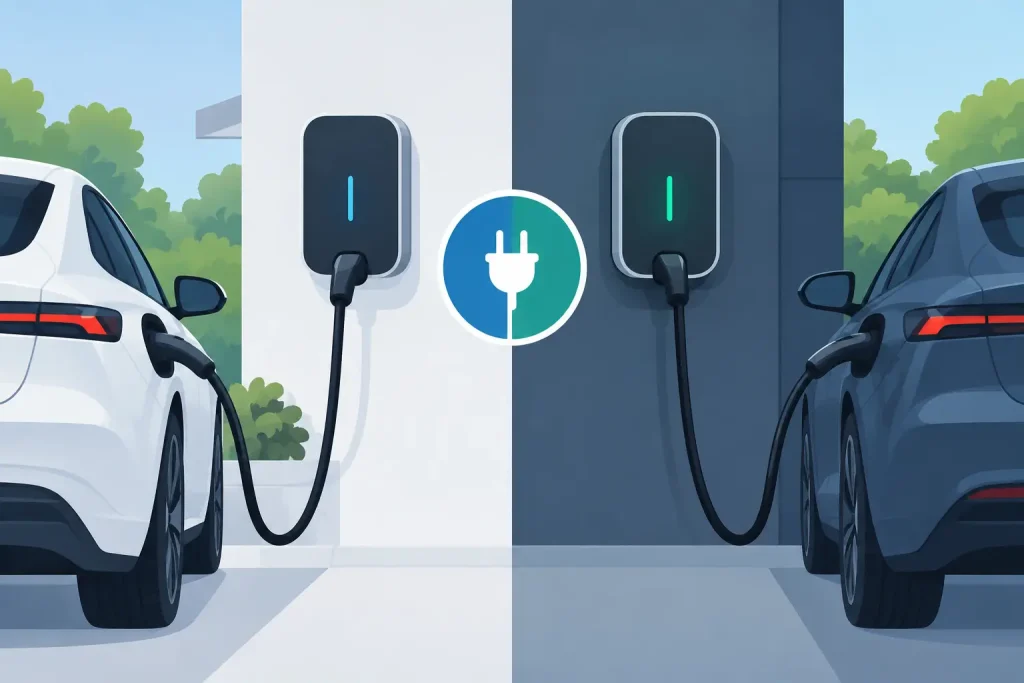
24 Amp Versus 48 Amp: The Real-World Difference
At 240 volts, a 24-amp charger delivers about 5.8 kilowatts of power. A 48-amp charger delivers about 11.5 kilowatts – nearly twice as much. That difference affects how quickly your vehicle recovers the miles you used during the day.
For many EVs, a 24-amp setup adds approximately 18 to 25 miles of range per hour. A 48-amp setup often adds about 35 to 45 miles per hour. Actual results vary by vehicle efficiency, battery temperature, and the vehicle’s onboard charging limit, but the general gap is significant.
Consider a driver who travels 40 miles most weekdays. A 24-amp charger can usually replace that energy in about two hours. If the vehicle is parked overnight, faster charging may not add much day-to-day convenience. But if someone arrives home late, leaves early, shares charging with another EV, or regularly drives 100 miles or more, 48 amps provides useful flexibility.
The key point is simple: 48 amps is faster, but faster is only valuable when it solves a real scheduling need.
What Each Charging Speed Requires
EV charging is considered a continuous electrical load. That means the circuit must be sized above the charger’s operating amperage rather than matched to it exactly.
A 24-amp charger generally requires a dedicated 30-amp, 240-volt circuit. A 48-amp charger generally requires a dedicated 60-amp, 240-volt circuit. The difference may sound small, but it can change the installation scope considerably.
A 30-amp circuit uses less capacity in the electrical panel and may require less expensive wiring and equipment. It can be a practical option for older homes, homes with limited available panel space, or properties where an electrical upgrade is not justified by the owner’s charging needs.
A 60-amp circuit requires larger conductors, a larger breaker, and more available electrical capacity. Depending on the distance between the panel and charger location, the added material and labor can affect the installation price. If the panel is already heavily loaded, a licensed electrician may need to evaluate whether a load calculation, panel upgrade, or load-management solution is needed.
This is why charger selection should happen alongside an installation assessment. A 48-amp charger is not automatically the best purchase if the home cannot support it efficiently or safely.
Hardwired vs. Plug-In Charging
Most 48-amp home charging setups are hardwired. A standard 240-volt receptacle is commonly limited to 40 amps of continuous EV charging, even when the circuit breaker is rated at 50 amps. Hardwiring a properly rated charger is the typical path for charging at the full 48-amp rate.
A 24-amp charger can be hardwired or plug-in, depending on the equipment and circuit. However, the receptacle, wiring, breaker, and charger settings must all be matched correctly. Using adapters or relying on an existing outlet without confirming its condition is not a substitute for a proper EV charging installation.
A dedicated circuit, quality components, correct torque specifications, and permit compliance matter. EV charging places a sustained load on the electrical system for hours at a time, which is different from briefly using a high-power appliance.
Your EV May Set the Limit
The charger on the wall is technically an EVSE, or electric vehicle supply equipment. It safely delivers power to the vehicle, but the vehicle decides how much AC power it can accept.
Some EVs are limited to 24, 32, or 40 amps for Level 2 charging. If your vehicle’s onboard charger cannot accept 48 amps, installing a 48-amp circuit will not make that particular vehicle charge faster. It could still be a worthwhile investment if you expect to replace the vehicle later or add another EV, but it should be a deliberate future-proofing decision.
Many newer EVs can accept 48 amps or more on Level 2 power, while others have lower limits based on trim level, model year, or manufacturer design. Before selecting equipment, confirm the vehicle’s maximum AC charging rate rather than relying on the battery size alone. A larger battery does not always mean a higher Level 2 charging limit.
When 24 Amps Is the Better Choice
A 24-amp installation is often the sensible choice for drivers with predictable overnight parking and modest daily mileage. If your vehicle sits at home for eight to 10 hours most nights, charging speed beyond your daily needs may simply go unused.
It can also be a smart approach when the electrical panel has limited capacity. Rather than forcing a costly service upgrade, a properly installed 24-amp charger may deliver dependable home charging at a lower overall project cost. For many homeowners, that is a better outcome than paying for capability they rarely use.
This option works particularly well for a single EV household, retirees who drive locally, hybrid workers, and drivers who have access to workplace charging during the day. It can also be a strong fit for a condo or multi-unit property where available electrical capacity must be shared among several residents.
Choosing 24 amps does not mean settling for slow charging. Compared with a standard household outlet, it is a major improvement and can restore a typical day of driving in a fraction of the time.
When 48 Amps Is Worth It
A 48-amp charger earns its place when time matters. Households with two EVs can rotate charging more easily. Drivers with long commutes can recover a full day’s use quickly. Busy families can arrive home, charge for a few hours, and be ready for evening plans or an early departure.
It is also worth considering for drivers whose schedules are not predictable. If you often get home at 9 p.m. and need to leave again at 6 a.m., faster Level 2 charging creates more margin. The same is true for rideshare drivers, real estate professionals, home health workers, and anyone whose vehicle use can change from one day to the next.
For a home already equipped with sufficient panel capacity, choosing a 60-amp circuit during a new installation can be an efficient long-term decision. The incremental cost may be reasonable when the charger location is close to the panel and no upgrades are needed. On the other hand, if reaching 48 amps requires a major panel or service upgrade, the additional cost deserves a closer look.
Look Beyond the Charger Rating
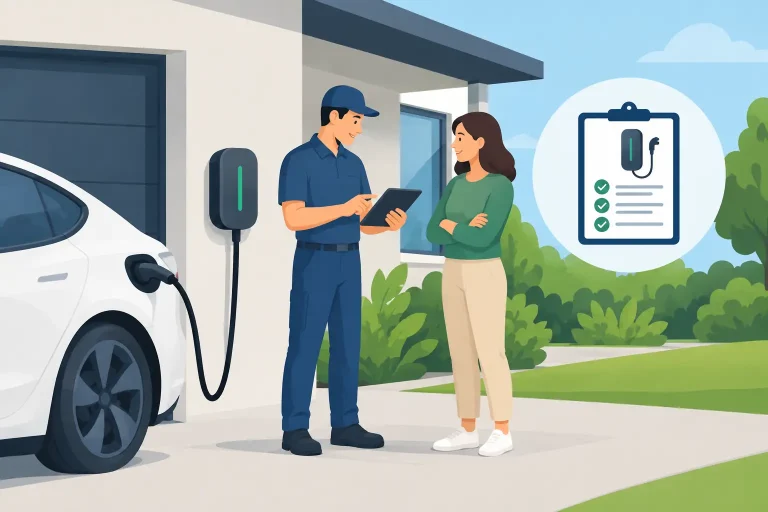
The best installation balances charging speed with the whole electrical picture. An electrician should review panel capacity, the distance to the charging location, available breaker space, wire routing, local permit requirements, and the charger model’s specifications.
In Los Angeles County, permitting and electrical requirements can vary by jurisdiction and property type. Single-family homes are usually more straightforward than condos, apartment buildings, or properties with shared meters. For multi-unit sites, a lower charging rate paired with load management may allow more residents to charge without overbuilding the electrical infrastructure.
Cost should also be evaluated as a project total, not only as the price of the charger. A less expensive 48-amp charger can become the more costly option if it triggers extensive electrical work. Conversely, installing capacity for 48 amps while walls or trenches are already open may be more cost-effective than upgrading later.
Plug-in LA helps homeowners and property decision-makers evaluate these details before installation, so the selected charging rate supports the property rather than creating unnecessary expense or electrical limitations.
Choose for Your Routine, Not the Spec Sheet
If your EV is parked overnight and your daily driving is moderate, 24 amps may provide all the charging convenience you need. If your household needs faster turnaround, has multiple EVs, or wants room for changing driving habits, 48 amps can be a worthwhile upgrade.
The right answer is not always the highest number. It is the charging setup that reliably has your vehicle ready when you are – installed on a properly sized circuit by qualified professionals who account for the entire electrical system.